
What Local SEO Services Include and How to Choose One
Three local SEO agencies have sent quotes. One promises “complete Google domination,” another offers a cheap listing package, and the third talks about content, reviews, and reporting without specifying what anyone will do. The prices are far apart, yet the proposals look strangely similar.
That confusion is normal. Local SEO services are often sold as a bundle of activities, while the buyer needs a clear connection between each activity, the customer journey, and the business outcome. A serious provider should explain what gets changed, who owns the accounts, how accuracy is maintained, what happens when a customer posts a damaging review, and which results are realistic.
This guide treats local SEO as a purchasing decision, not a sales pitch. It covers the deliverables inside a credible package, Google's own limits on local rankings, the shift from review volume toward reputation operations, pricing models, timelines, agency vetting, and practical work a business can start without hiring anyone.
Table of Contents
- Introduction to Buying Local SEO Services
- What Local SEO Services Actually Are
- What a Local SEO Service Package Includes
- Reviews and Reputation Management in Practice
- Choosing a Provider When Local SEO Isn’t the Only Problem
- Pricing Models and Realistic Timelines
- How to Vet a Local SEO Agency
- DIY Local SEO Tactics You Can Start Today
- Putting It All Together and Next Steps
Introduction to Buying Local SEO Services
A local business rarely loses visibility because its owner forgot that search engines exist. More often, the problem is fragmented information. The website lists one opening time, a directory shows another, the Google Business Profile uses an outdated category, and several reviews mention an issue nobody answers. Customers searching nearby see uncertainty before they see the business.
That matters because local search often sits close to a decision. Someone is choosing a dentist, restaurant, repair company, solicitor, or tradesperson, not browsing for entertainment. BrightLocal's 2025 Consumer Search Behavior study surveyed 1,000 U.S. adults and found that 39% estimated at least 41% of their searches are dedicated to finding local businesses. The same study found that 85% consider accurate contact information and opening hours important when researching a local business.
An agency can help, but the contract needs scrutiny. “Monthly SEO” might mean a genuine programme of profile improvements, technical fixes, local pages, review monitoring, and authority development. It might also mean a recurring report and a handful of directory submissions that don't address the actual bottleneck.
The buyer should expect clarity in five areas:
- Scope: Which profiles, pages, platforms, and locations will the provider manage?
- Operations: Who checks listings, reviews, profile edits, and factual corrections?
- Measurement: Are reports tied to calls, enquiries, booked appointments, or only rankings?
- Limits: Does the agency acknowledge distance, competition, and Google's ranking constraints?
- Ownership: Does the business retain access to its Google Business Profile, website, analytics, and review accounts?
The right service isn't necessarily the largest package. A single-location business with incorrect hours may need a focused cleanup before it needs a long content programme. A multi-location brand may need central governance, location-level reporting, and review escalation rules. The contract should follow the problem, not the other way around.
What Local SEO Services Actually Are
Traditional SEO competes for attention across broad markets. Local SEO is narrower and more operational. It helps a business become understandable and trustworthy in the places where it serves customers, including map results, business profiles, directories, review platforms, local pages, and relevant social channels.
A useful analogy is a high street. General SEO is like trying to make a national directory recommend a business anywhere in the country. Local SEO is like ensuring the shop has the right sign, address, opening hours, category, directions, reputation, and local references on every guide a visitor might consult.
The work usually combines four connected systems:
- Structured location information, including the business name, address or service area, phone number, categories, opening hours, and services.
- Maps visibility, particularly through Google Business Profile and other location platforms.
- Reputation management, including review monitoring, responses, escalation, and factual corrections.
- Local discovery beyond traditional results, including social profiles and locally relevant content.
The distinction from general SEO is practical. A national ecommerce programme may prioritize product architecture and broad informational content. A local programme must also answer whether the business is open, where it is located, which service it provides, whether customers trust it, and whether the information is consistent across platforms.
BrightLocal's research also found a generational difference in discovery. One in four Gen Z consumers uses social media as their primary method for local search, according to the same 2025 study. That doesn't mean Google Maps has become irrelevant. It means a local presence now has to remain coherent wherever customers look.
A provider should therefore describe local SEO as an ongoing information and reputation operation, not a keyword insertion exercise. Keywords still help pages and profiles communicate relevance, but they can't correct a wrong address, resolve a misleading review, or overcome a business that sits outside the searcher's practical service area.
Practical rule: If a proposal lists tasks but never explains how those tasks improve customer confidence or qualified actions, the package is probably activity-led rather than business-led.
What a Local SEO Service Package Includes
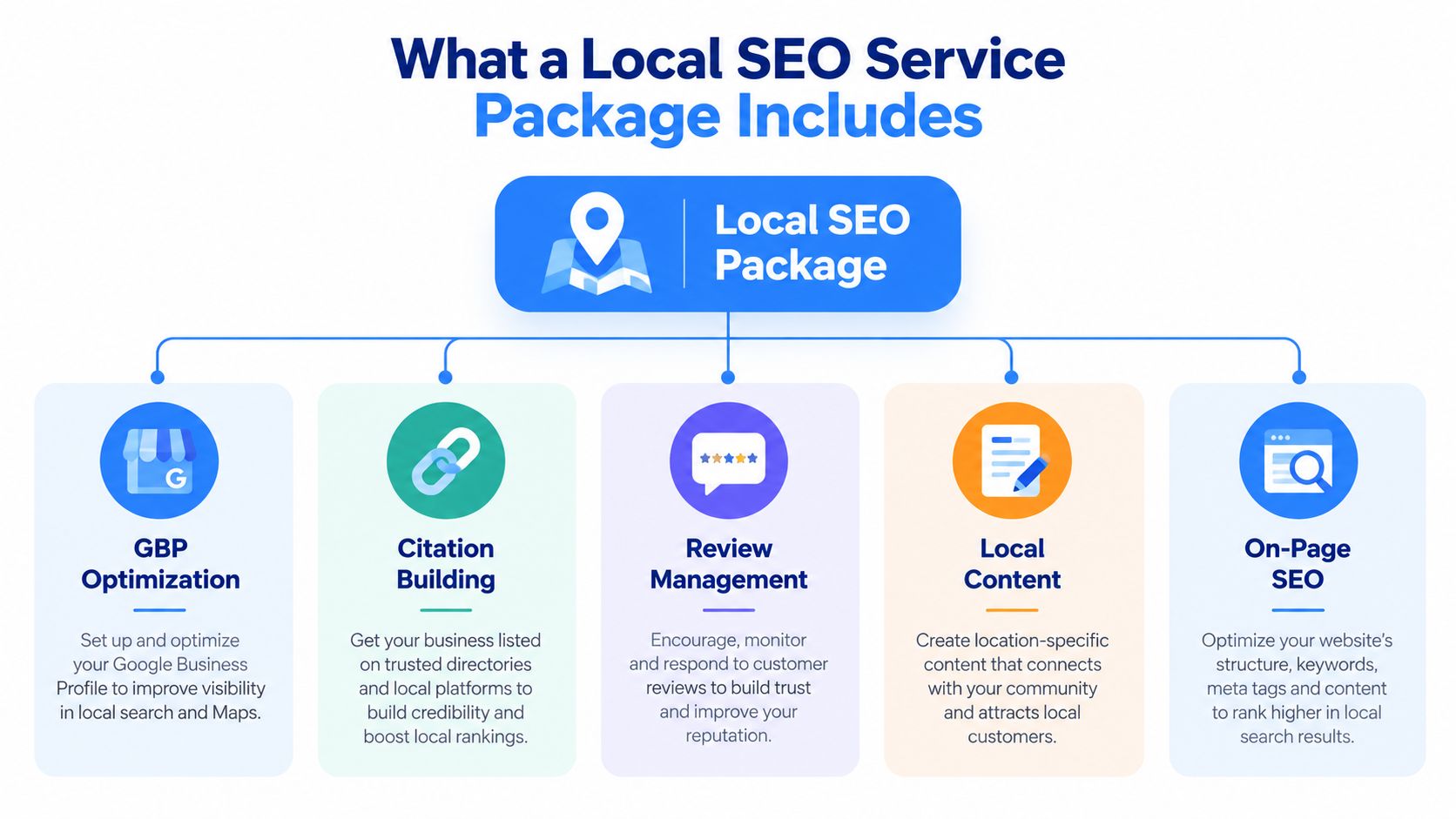
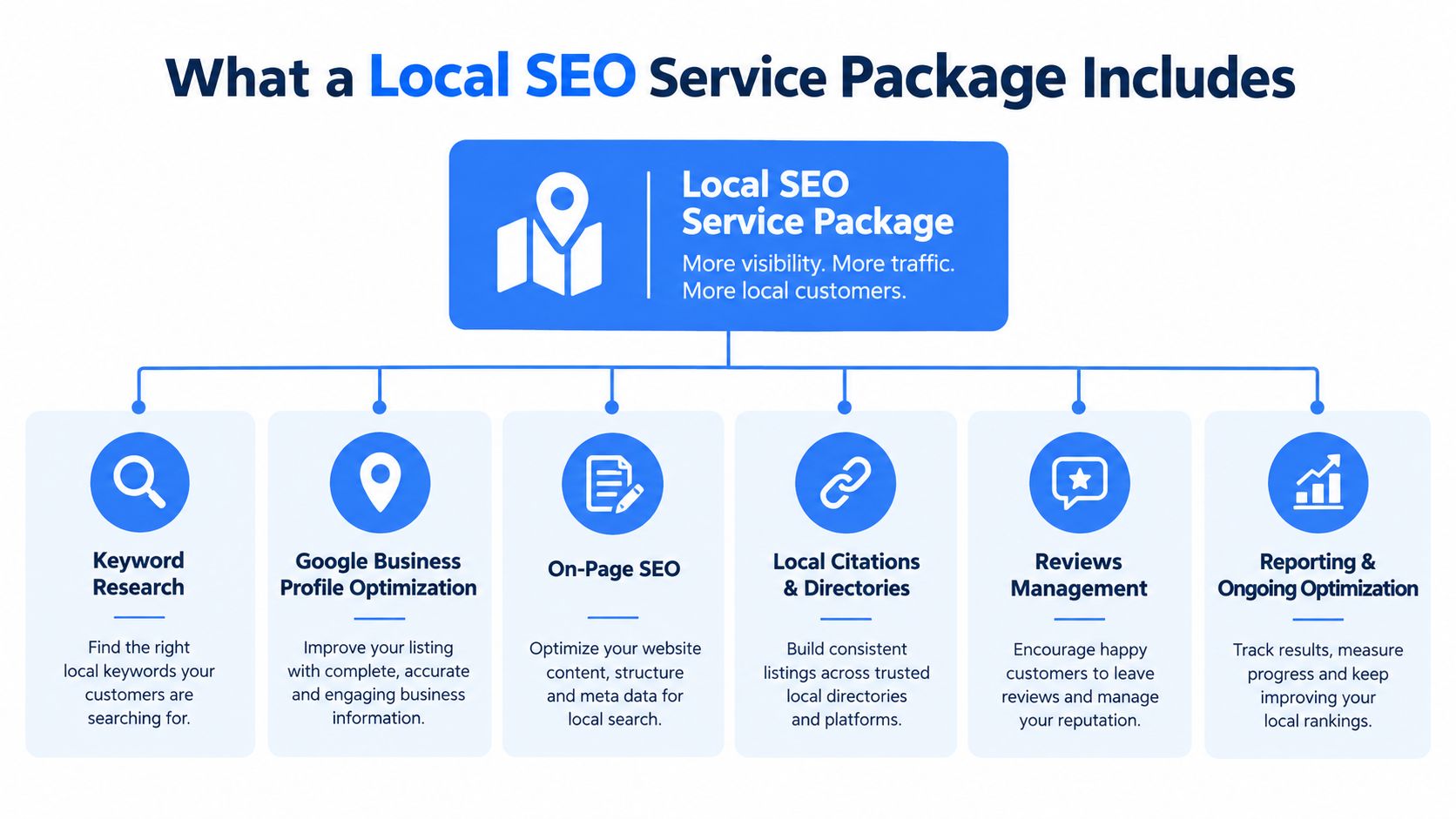
A credible package has a sequence. The provider should establish accurate business data first, then improve the website and profile experience, then build reputation and authority around a stable entity. Buying isolated citations or blog posts before fixing the core information usually creates motion without much progress.
Google Business Profile comes first
Google describes local results through relevance, distance, and prominence in its official guidance on local ranking. Relevance concerns how closely a profile matches a query. Distance concerns proximity to the searcher or the location inferred from the search. Prominence reflects how well known the business is, with signals that can include links, review volume, and ratings.
The first deliverable should be a documented profile audit and correction plan. It should cover:
- The real-world business name, without unnecessary keyword additions.
- The correct primary category and suitable secondary categories.
- The precise address or eligible service area.
- Current opening hours and special hours.
- A working phone number and website.
- Accurate service descriptions, attributes, photos, and business details.
Google states that complete and accurate information makes a business more likely to appear in local results. It also says businesses can't request or pay for a better organic local ranking. That makes guaranteed Map Pack placement a red flag, not a premium feature.
Citations support consistency
Citations are business references across directories, mapping services, social profiles, review sites, and relevant local publications. The value isn't the raw count of listings. The practical value is whether important platforms carry the same entity information and whether duplicate or obsolete records create confusion.
A finished citation deliverable should show:
- The platforms reviewed.
- Incorrect names, addresses, phone numbers, categories, or hours.
- Duplicate listings identified.
- Corrections submitted and their status.
- The locations or sources that still need manual verification.
For a service-area business, the provider should also explain how it handles address privacy and service boundaries. A directory blast that creates low-quality or inaccurate listings can be worse than a smaller, carefully selected set of relevant references.
Website and technical work make the entity usable
Local SEO isn't limited to a profile. The site should make the business, services, and locations easy to understand. Typical work can include service pages, genuine location pages, title and heading improvements, internal links, mobile usability, indexation checks, page speed diagnostics, and structured data where appropriate.
A location page should contain more than a city name swapped into a template. It may need local access information, service boundaries, parking or travel details, staff or facility information, and proof that the business serves that area. For multi-location organizations, each page should represent a real location rather than a thin duplicate.
A proposal should identify the actual implementation path. Will the agency edit the website, provide tickets for the client's developer, or only make recommendations? A technical audit without a responsible implementer is advice, not completed work.
Reviews need an operating system
Review work includes more than sending customers a link. A serious service defines how the business requests feedback, monitors platforms, responds, identifies factual errors, and escalates sensitive complaints.
The contract should specify whether the team:
- Monitors Google and other important review platforms.
- Drafts responses for approval or publishes them.
- Escalates allegations involving safety, privacy, discrimination, or legal issues.
- Tracks recurring service complaints.
- Requests corrections when a review contains demonstrably wrong business information.
- Keeps a record of response times and unresolved issues.
Local content and authority come later
Content should answer real local questions and support commercial journeys. Useful examples include service explanations for a defined area, access guidance, local project pages, frequently asked questions, and genuinely local resources. Generic articles with place names inserted rarely create durable differentiation.
Link building should follow the same standard. Relevant local organizations, suppliers, professional bodies, community groups, and publications can provide legitimate context. Paid, irrelevant, or mass-produced links may create risk without establishing genuine prominence.
A complete monthly report should connect the work to observable outcomes, such as profile actions, calls, direction requests, qualified forms, review response coverage, corrected listings, indexed pages, and technical issues resolved. Rankings can be useful diagnostics, but they shouldn't be the only proof of value.
Reviews and Reputation Management in Practice
A business can have plenty of recent reviews and still lose the sale. The usual failure point is simpler. hours are wrong, complaints sit unanswered, or the responses read like copied scripts. That is why review management is a buying decision, not just a visibility tactic.
BrightLocal's 2025 Local Consumer Review Survey surveyed 1,026 U.S. adults and found that 74% check reviews on at least two platforms when researching a local business. Google led at 83%, followed by local news outlets at 48%, Yelp at 44%, Facebook at 40%, and YouTube at 34%. For an owner hiring an agency, the practical question is which of those platforms your customers use, and whether the agency will monitor them to the same standard.
That changes the brief for reputation work. A good provider does not chase every platform equally. It identifies the places that influence real buying decisions, checks that business details match, and makes sure replies do not vary wildly from one platform to another.
Responsiveness carries meaning
The same survey found that 89% of consumers would be more likely to use a business that responds to all reviews, compared with 44% who would choose a business that doesn't respond to reviews at all. Response activity is not a guaranteed ranking boost. It does show potential customers that someone is paying attention and that complaints are handled rather than ignored.
Good responses are usually short, specific, and calm. Thank positive reviewers without stuffing in service keywords. For negative reviews, acknowledge the issue, offer an offline path to resolve it, and avoid arguing in public. Never disclose private customer details. Never promise a refund, fix, or callback unless the business can deliver it.
The operating process matters more than the wording. Agencies often sell response templates. Templates help with speed, but they are weak on edge cases, and edge cases are where risk lives.
A useful workflow separates routine feedback from issues that need a manager or legal review:
- Service dissatisfaction: acknowledge the experience, invite private contact, and route the issue to the responsible manager.
- Factual errors: verify the record, correct the business information where possible, and respond without exposing private details.
- Safety or discrimination allegations: escalate immediately to an appropriate senior person instead of posting an automated reply.
- Privacy concerns: remove sensitive details from the response process and follow the business's privacy procedure.
- Suspected manipulation: document the concern and use the platform's reporting process rather than retaliating publicly.
Accuracy matters in AI-assisted discovery
A 2025 local-search survey reported that 75% of consumers read at least four reviews before deciding, while 53% are unlikely to visit a business with incorrect listings. It also reported that 59% expect a response within 24 hours, 60% click AI-generated Google overviews, and 32% consider AI-driven recommendations important, according to the reported survey findings.
Those numbers shift what you should ask an agency. Ask how it finds outdated hours, wrong service descriptions, duplicate listings, unanswered complaints, and repeat service issues that could shape AI summaries as much as star ratings do.
A review programme without an escalation process is publishing risk faster than it is building trust.
The deliverable should be concrete: a response policy, approval rules, monitoring cadence, correction log, and theme reporting. If a provider cannot show what was answered, what was escalated, what information was corrected, and which complaints point to an operational problem inside the business, it is selling activity rather than reputation management.
Choosing a Provider When Local SEO Isn’t the Only Problem
seopaslaugos.io is an Lithuanian based SEO service for service businesses and ecommerce companies that want SEO connected to calls, enquiries and sales rather than traffic alone. The work combines technical SEO, commercial service and city pages, external authority work, Google Business Profile optimisation, AI visibility, conversion tracking, ecommerce SEO, and website development where the existing platform restricts progress.
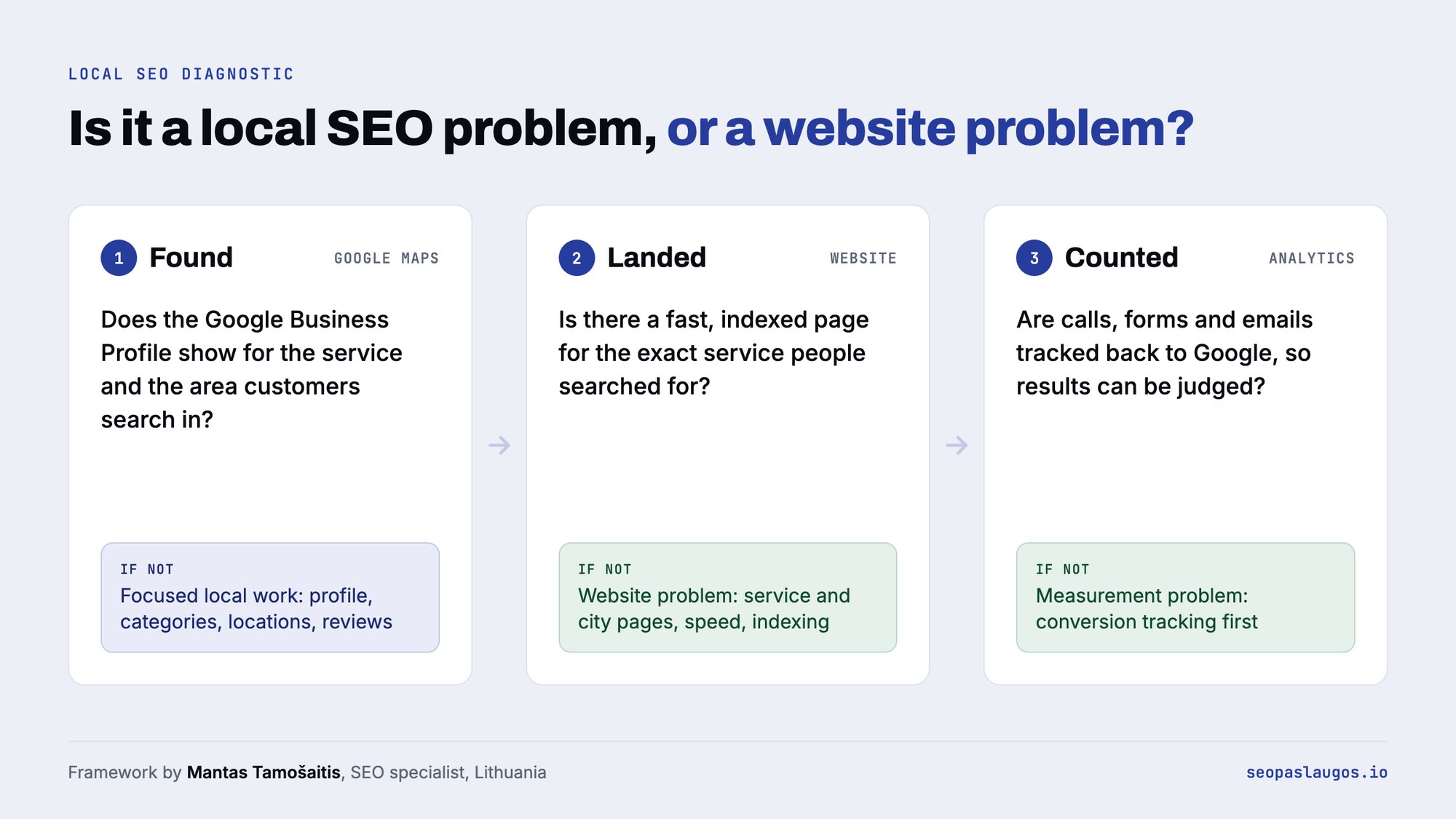
That breadth is useful when local visibility is not the only constraint. A service company with weak map presence but strong website foundations may need a focused local programme. A company with slow pages, poor indexing, thin commercial content, and no conversion tracking needs a broader intervention before local SEO can be judged fairly.
“A Google Business Profile can only send people to the website you have. If the service page is missing or calls aren’t tracked, local SEO gets blamed for a website problem.”
Mantas Tamošaitis, SEO specialist, seopaslaugos.io
The provider distinguishes between work on the client’s site and a partnership model for service businesses that doesn’t use a monthly fee and instead pays from agreed orders. That model can reduce fixed cost, but it requires precise definitions of qualified leads, attribution, sales ownership, refunds, and reporting. Businesses should compare those terms with a conventional retainer rather than assuming performance pricing is automatically cheaper.
| Approach | Useful when | Buyer should clarify |
|---|---|---|
| Focused local engagement | The main issue is profile, location, or map visibility | Which platforms and locations are included |
| Broader SEO engagement | Technical, content, authority, and conversion problems overlap | Who implements website changes |
| Partnership from agreed orders | The business can define and verify attributable orders | Lead ownership, exclusions, payment timing, and dispute rules |
The stated emphasis on direct specialist collaboration, commercial-intent keywords, analytics, and transparent reporting may suit an owner who wants one team across technical, content, local, and measurement work. It is less suitable for a buyer seeking a narrowly limited citation cleanup or a guaranteed ranking outcome. Before signing, the business should review the scope of the provider's seo services, then ask for a local deliverables list rather than relying on the general service menu.
Pricing Models and Realistic Timelines
A local SEO quote often looks simple until you ask what the business is buying. One agency sells a low monthly fee that covers a few directory submissions and a ranking report. Another charges more but includes Google Business Profile work, review response handling, service page updates, technical fixes, and reporting tied to calls or leads. The price matters, but the scope matters more.
Local SEO is usually sold through three commercial models. None is automatically right. The best fit depends on how many locations you operate, whether your team can implement changes internally, how much cleanup is needed, and whether you need a one-off fix or steady work over time.
| Pricing model | Typical scope | Best fit | Main trade-off |
|---|---|---|---|
| Monthly retainer | Ongoing profile work, technical tasks, content, reviews, reporting, and authority development | Businesses with continuing competition or multiple workstreams | Requires trust over time and careful monthly scope control |
| One-time project or audit | Baseline audit, listing cleanup, profile setup, technical recommendations, or a defined implementation | Owners who can execute internally or need a focused intervention | Doesn't provide ongoing monitoring or compounding content and authority work |
| Performance or per-location pricing | Payment linked to agreed outcomes, locations, or a defined partnership arrangement | Businesses with reliable tracking and clear sales processes | Attribution disputes and unclear definitions can create conflict |
Monthly retainers work best when local SEO is not a single problem. If the business needs profile management, website improvements, reputation operations, and measurement at the same time, ongoing work makes sense. The contract should still spell out what happens each month. “Ongoing optimization” says very little. Buyers should see whether the retainer includes profile edits, listing corrections, review monitoring and responses, page updates, technical implementation, outreach, and reporting.
What the timeline should look like
The first phase is usually operational. Access gets sorted out. Tracking is checked. Profiles are completed, inconsistent listings are corrected, technical issues are identified, and obvious conversion blockers are addressed. This work can improve the accuracy and usefulness of what customers see, but it does not remove distance limits or produce local prominence on demand.
Then comes the slower part. Useful local and commercial pages need to be published or improved. Internal linking needs to support those pages. The business may need relevant mentions from other sites, plus a review process that staff can follow consistently. In competitive areas, this stage takes patience because other businesses may already have stronger relevance, authority, and a more established reputation.
The later review should connect completed work to real business capacity. More calls are not a win if no one answers them. Better rankings are not enough if the leads are poor, the offer is weak, or tracking is broken. This is also where agency promises need a reality check. A provider can improve accuracy, visibility, and conversion paths. It cannot fix missed calls, bad intake, or slow follow-up inside the business.
Questions that expose weak proposals
A provider should be able to answer these questions in writing:
- Which assets will the agency access and manage?
- What will be delivered in the first reporting period?
- Which tasks require client approval or developer support?
- How are calls, forms, bookings, and sales attributed?
- What happens when a review raises a safety, privacy, or legal concern?
- How are multi-location profiles separated and governed?
- Which work is excluded or charged separately?
- What happens to accounts, content, listings, and reports when the contract ends?
Underpricing is not always a problem. Sometimes it reflects a narrow engagement with a clear boundary. The risk appears when a small package is presented as if it covers strategy, implementation, reputation operations, and growth across every location.
A stronger closing test is simpler. Match the fee to the workload, the business model, and the pace your team can support. If the proposal ignores review response operations, account ownership, implementation responsibility, or lead handling after the click, the timeline will look better on paper than it does in practice.
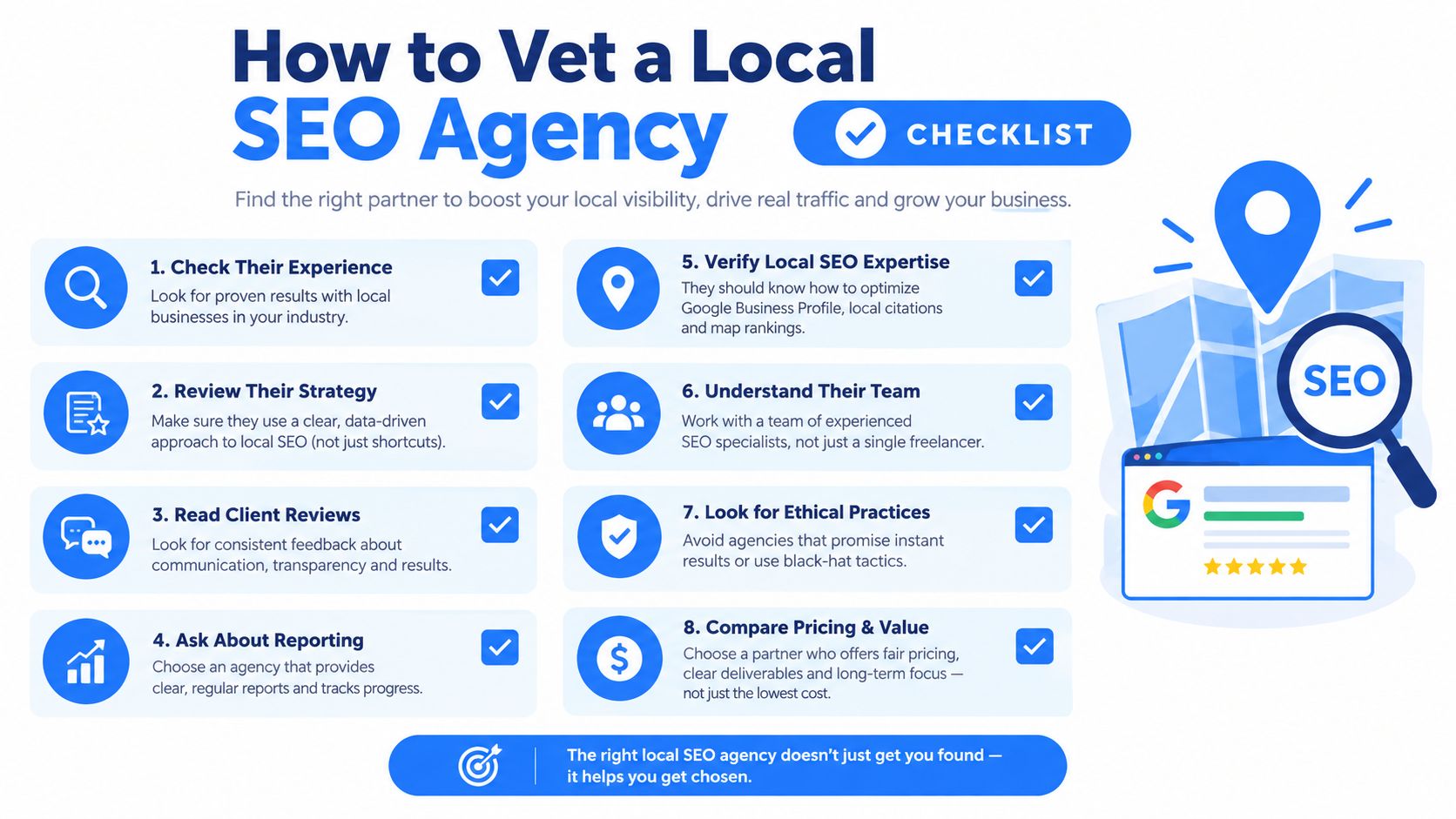
How to Vet a Local SEO Agency
A typical buying mistake looks like this. A business owner takes three agency calls, hears three confident pitches, and still has no clear view of who will touch the website, who will respond to reviews, or how results will be reported. The safest proposal is usually the one that makes the work visible.
Start by checking the agency the way a customer would. Search its business name, inspect its profile, read recent reviews, and compare its contact details across visible listings. That will not prove the team can rank a client in a competitive area, but obvious errors on its own assets are a fair warning. If an agency sells accuracy, its own basics should hold up.
Then ask for a redacted monthly report. A useful sample does more than show rankings. It should let you trace what happened, what is blocked, and what the business got from the work.
- Completed work: what changed, where it changed, and when it was done.
- Open issues: what is still blocked, what depends on the client, and what depends on a developer or third party.
- Reputation operations: reviews monitored, responses handled, and cases waiting for approval or escalation.
- Business outcomes: calls, enquiries, bookings, or sales where tracking is in place.
- Interpretation: what the agency recommends next, and what trade-off sits behind that recommendation.
Account ownership matters just as much as reporting. The business should control the Google Business Profile, website, analytics, call tracking, domain, and major directory accounts. Agencies can work through delegated access. They should not create a setup that becomes inaccessible when the contract ends.
The review test
Ask the provider to walk through a difficult review case. Do not settle for a description of how it asks happy customers for more ratings. A credible answer covers factual disputes, privacy concerns, safety allegations, response timing, approval rules, and who owns the escalation internally.
As noted earlier, recent local search findings showed that people read several reviews, expect timely responses, and increasingly encounter AI-generated summaries before they decide who to contact. That changes the buying test. Review volume still matters, but accuracy and response operations matter more than a simple request campaign if the goal is better discovery and fewer lost leads.
The ranking test
Ask a blunt question: “Can you guarantee Map Pack placement?” If the answer is yes, keep looking. Google's own local ranking documentation says local results depend primarily on relevance, distance, and prominence, and businesses cannot pay for better organic local ranking.
A serious agency will explain the boundary clearly. It can improve completeness, relevance, consistency, technical accessibility, local authority, and review response handling. It cannot move a business closer to every searcher or sell an organic position.
Decision rule: Choose the provider that explains the limits before it sells the upside.
DIY Local SEO Tactics You Can Start Today
A lot of local SEO buying mistakes start with problems you can spot in an afternoon. Before paying for a monthly retainer, fix the obvious items and see what changes. That gives you a clearer read on whether you need help with basic profile accuracy, review handling, technical work, or ongoing content.

A dental practice with the wrong category
A dental practice searches its own brand name and finds an outdated primary category, missing service details, and holiday hours that no longer apply. Start there. Confirm the actual business information first, then choose the category that matches the core service, update service listings and hours, upload current photos, and make sure the same details appear on the website.
That kind of cleanup will not tell you whether an agency can build authority or improve technical SEO. It will tell you whether customers can understand what you do, when you are open, and which location to call. If those basics are off, paying for more advanced work too early usually wastes money.
A restaurant with inconsistent hours
A restaurant may have correct hours on Google and old hours on a directory, social profile, or booking page. Staff should create one simple source-of-truth document with the business name, address, phone number, regular hours, holiday hours, menu link, and reservation link. Then update the profiles customers are most likely to see and set a calendar reminder before seasonal changes.
The point is simple. Contradictory hours are exactly the kind of inaccuracy that breaks trust before a visit. A checklist handled by the manager or front-of-house team is often enough to stop that drift, especially for a single-location business.
A home-services company with silent reviews
A home-services company often replies only when a complaint appears. That leaves too much to chance. Build a repeatable review request into the job-close process, ask for honest feedback without giving customers a script, and assign one person to monitor incoming reviews and route sensitive cases internally.
Responses need judgment, not volume. Thank satisfied customers in plain language. For negative reviews, acknowledge the issue, avoid private account details, and point the customer to a real resolution path. Keep a simple log of recurring complaints so operations can fix the service problem behind the review, not just the wording on the page.
Where DIY work stops paying back
DIY works best when one location, a manageable number of profiles, and a reliable staff owner keep the basics current.
It usually stops paying back when the business adds locations, needs regular local landing page work, runs into technical indexing or site issues, or has to monitor reviews across several platforms with consistent response rules. At that point, the question is no longer whether local SEO matters. It is whether someone inside the business can maintain the work accurately, on time, and with enough discipline to protect revenue. A good provider earns the handoff by taking on work the business cannot sustain and by showing exactly what it will implement, who owns each account, and how results will be reported.
Putting It All Together and Next Steps
The buying decision can start with a short internal audit.
- Search the business name and primary services from the service area.
- Check the Google Business Profile, website, opening hours, phone number, categories, and service details.
- Compare the same information on major directories, social profiles, and review platforms.
- Read recent reviews and identify unanswered, inaccurate, or recurring complaints.
- Decide whether the bottleneck is basic accuracy, reputation operations, website conversion, technical accessibility, or authority.
- Ask agencies to price the bottleneck specifically, with implementation responsibilities and account ownership stated in writing.
A business that finds incorrect information should fix the obvious items immediately. A business with stable listings but weak trust signals needs a response and escalation process. A business with multiple locations or sustained content and authority needs a programme that can operate beyond occasional profile edits.
Local discovery is also spreading across different interfaces. BrightLocal found that one in four Gen Z consumers uses social media as a primary local-search method, while reported survey findings show that consumers engage with AI-generated Google overviews and AI-driven recommendations. The next useful local SEO service will therefore combine accurate structured data, credible reputation operations, strong commercial pages, and measurement of qualified actions.
Choose a provider only after the scope survives detailed questions. If the business needs to publish and coordinate social updates across several networks as part of its broader local visibility workflow, PostWing can help schedule text, image, and video posts from one calendar, with platform-specific customization and account-based plans. Start this week by correcting the public facts customers rely on, then use the vetting checklist to buy only the work the business needs.