
Social Media Moderation: Policies and Workflows That Work
Facebook acted on 836 million spam cases in the early months of 2018, according to MIT Technology Review's account of its enforcement disclosures. Social media moderation isn't occasional comment cleanup. It's an ongoing publishing operation involving account integrity, audience safety, platform rules, and decisions about which conversations deserve a response.
For a brand publishing across networks, the challenge isn't just deciding whether a post is acceptable. The team must decide whether each version is appropriate for its destination, audience, and language, then prepare for restrictions or harmful replies after publication.
Table of Contents
- What Social Media Moderation Covers Today
- Moderation Approaches Compared Side by Side
- Why Moderation Breaks Down at Scale
- How to Write a Moderation Policy
- How Exerta Can Help
- Review and Response Workflow by Severity
- A Campaign Post Across Eight Networks
- Handling Wrongful Removals and Incidents
- Set Up Your Moderation Workflow This Week
What Social Media Moderation Covers Today
Social media moderation is the set of decisions that determine what content stays visible, receives reduced distribution, or comes down. For brands, it also includes handling comments, direct messages, tagged posts, and mentions.
A moderator resembles a lifeguard at a busy pool: watching for risk, deciding when intervention is necessary, and calling for help when a situation exceeds their authority. The job requires judgment, not constant punishment.
Platform enforcement and community management
Platform moderation applies a network's rules to content and accounts. Community management applies a brand's published standards to interactions on the surfaces it controls. A customer complaint might deserve a helpful reply even when a scam comment beside it requires removal.
An academic analysis of the EU Digital Services Act Transparency Database examined 156 million statements of reasons over a two-month observation period and reported the enforcement shares below.
Enforcement actions in the EU DSA transparency data
| Enforcement action | Share of recorded decisions | What happens to the content or account |
|---|---|---|
| Removal | 55.15% | Content is removed from public view |
| Demotion | 25.15% | Content stays live but receives reduced distribution |
| Account suspension | 14.96% | The account loses access to some or all activity |
| Other restrictions | 4.74%, calculated remainder | Other visibility or access restrictions, such as labels or age limits |
Removal accounted for the majority, but moderation wasn't limited to deletion. A demoted post can remain accessible while reaching fewer people, making the restriction less obvious than a missing post.
These are shares of recorded decisions, not the likelihood that any particular brand post will face enforcement. Nor does every weak-performing post indicate moderation.
Practical rule: Publication status and moderation status belong in separate fields. A successful upload doesn't prove unrestricted distribution.
A brand therefore needs monitoring after publication, not just approval before scheduling. Reviewers should distinguish a platform restriction from an ordinary audience response or a technical publishing problem before choosing the next action.
Moderation Approaches Compared Side by Side
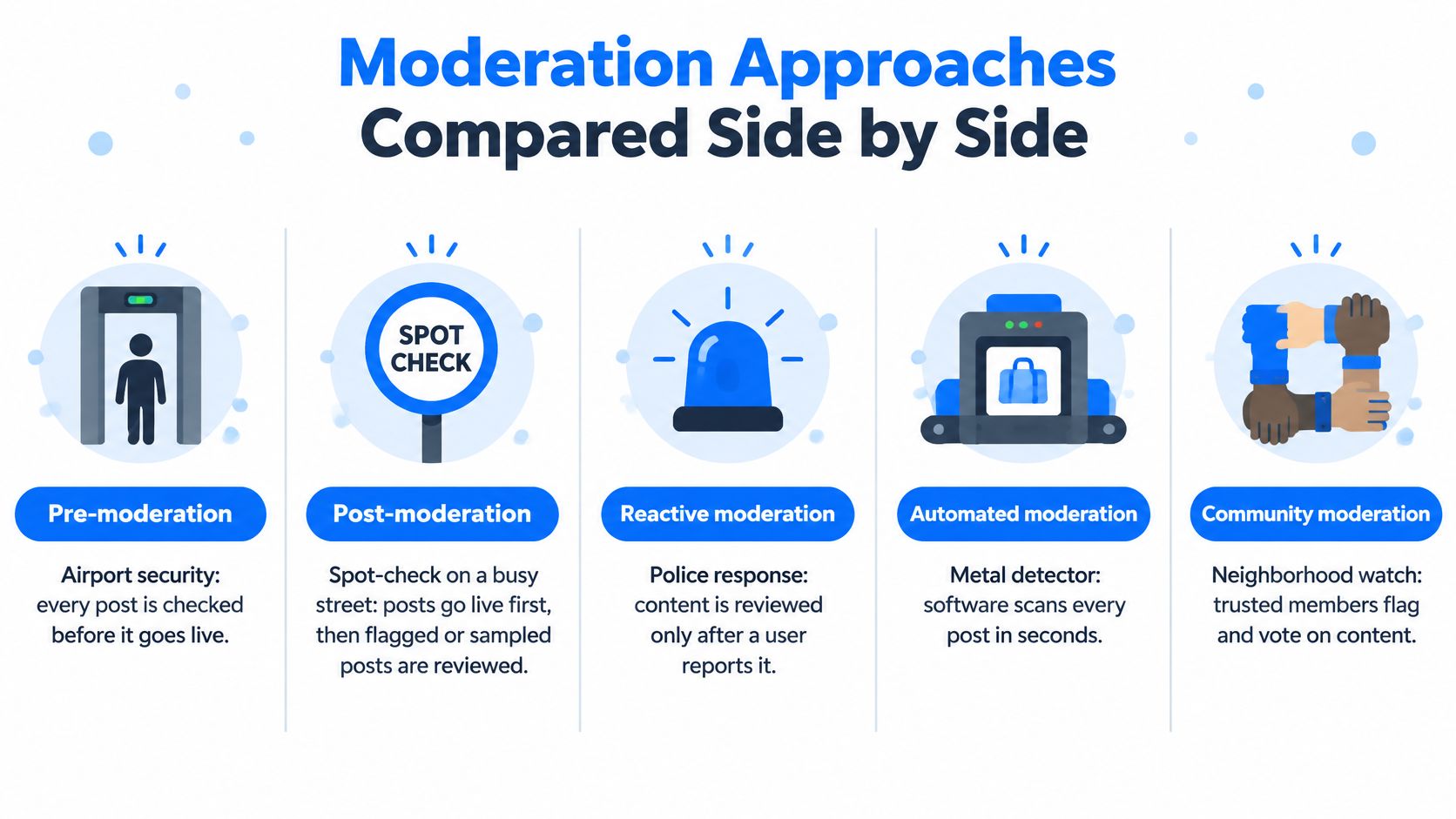
Pre-moderation resembles airport security: content waits for clearance before entering. Automated filtering resembles a metal detector: software identifies signals quickly but can't reliably determine intent.
Post-moderation is closer to a street spot-check, with review after entry. Reactive moderation begins when a neighbour reports a problem. Hybrid moderation combines machine sorting with trained reviewers who handle uncertain cases.
Moderation approaches compared
| Approach | How it works | Speed | Main risk | Best fit |
|---|---|---|---|---|
| Pre-moderation | Every submission receives review before appearing | Slow | Delays and staffing bottlenecks | Sensitive communities and high-stakes launches |
| Post-moderation | Content appears before entering a review queue | Fast publication | Harm remains visible until review | Lower-risk discussions with staffed oversight |
| Reactive, user reports | Review starts after a user flags content | Report-triggered | Unreported harm stays visible | Engaged communities with accessible reporting |
| Automated filtering | Keywords and classifiers screen content | Immediate screening | Incorrect blocks and missed violations | Repetitive spam and clear-cut violations |
| Hybrid | Software handles clear cases; people assess uncertainty | Fast for clear cases | Requires training and escalation rules | Brands managing substantial conversation volume |
The visual also includes community moderation, where trusted members flag or vote on content. That's a participation model rather than a replacement for accountable brand reviewers.
Choosing the right combination
In an analysis of approximately 150 million EU DSA moderation decisions, 60.67% were fully automated, while automation was involved in 89.45% of violation detections. Those figures describe platform enforcement, not a recommended staffing model for brands.
For a small team, hybrid moderation might mean automatically hiding repeated scam links while sending ambiguous insults to a reviewer. A reactive reporting option still matters because community members can identify context that filters miss. Reports need a visible destination and an assigned reviewer, not an unattended inbox.
Pre-publication review suits high-consequence brand content, while post-publication review keeps ordinary discussion moving. These methods can operate together.
The selection comes down to practical questions: How harmful would a mistake be? How much content arrives each day? When are reviewers available? A team without overnight coverage shouldn't describe its process as continuously monitored just because its filter runs continuously.
Why Moderation Breaks Down at Scale
Say a food brand publishes a joke using a regional idiom. A filter treats it as abuse, while a genuinely abusive reply in a less-supported language remains visible. Adding more automatic decisions wouldn't necessarily solve either problem.
Over-moderation restricts legitimate expression, including satire, reclaimed language, or reporting that quotes offensive words. Under-moderation misses harmful material. Both errors matter, but they require different corrections.

What accuracy hides
Precision asks how many flagged items were genuine violations. Recall asks how many actual violations the system caught. A filter that blocks almost everything may catch harmful comments while also suppressing legitimate discussion.
The Social Media Transparency research collection describes a 2025 dataset of 13,187 reports across seven EU languages, with the following removal rates.
EU removal rates by language group and platform
| Segment | Removal rate |
|---|---|
| Smaller or minority-language content | 23.3% |
| Major-language content | 40.2% |
| YouTube, overall | 71.3% |
| X, overall | 12.5% |
These are removal rates among reported content, not direct measures of classifier accuracy. Differences can reflect platform rules, the reports submitted, and enforcement practices. They nevertheless demonstrate why identical reporting or review instructions don't guarantee identical outcomes across destinations.
Reviewing local meaning
A multilingual team should maintain language-specific examples alongside its general categories. Reviewers need the surrounding conversation, intended audience, and explanation of unfamiliar expressions, not merely a translated keyword.
Unfamiliar language isn't evidence of harmful intent.
Borderline cases should reach a qualified speaker or market specialist. The audit log should distinguish an actual violation from a culturally unfamiliar phrase, allowing the team to evaluate errors by language and market rather than hiding them inside an overall accuracy score.
How to Write a Moderation Policy
A useful policy lets different reviewers reach the same decision for the same reason. Before defining violations, the policy owner should compare each network's current community rules with the brand's own standards and record meaningful differences.
The brand can choose stricter community standards, but it can't override a platform's restrictions. Reviewers also need to know which actions are available on each surface.
Building an actionable rulebook
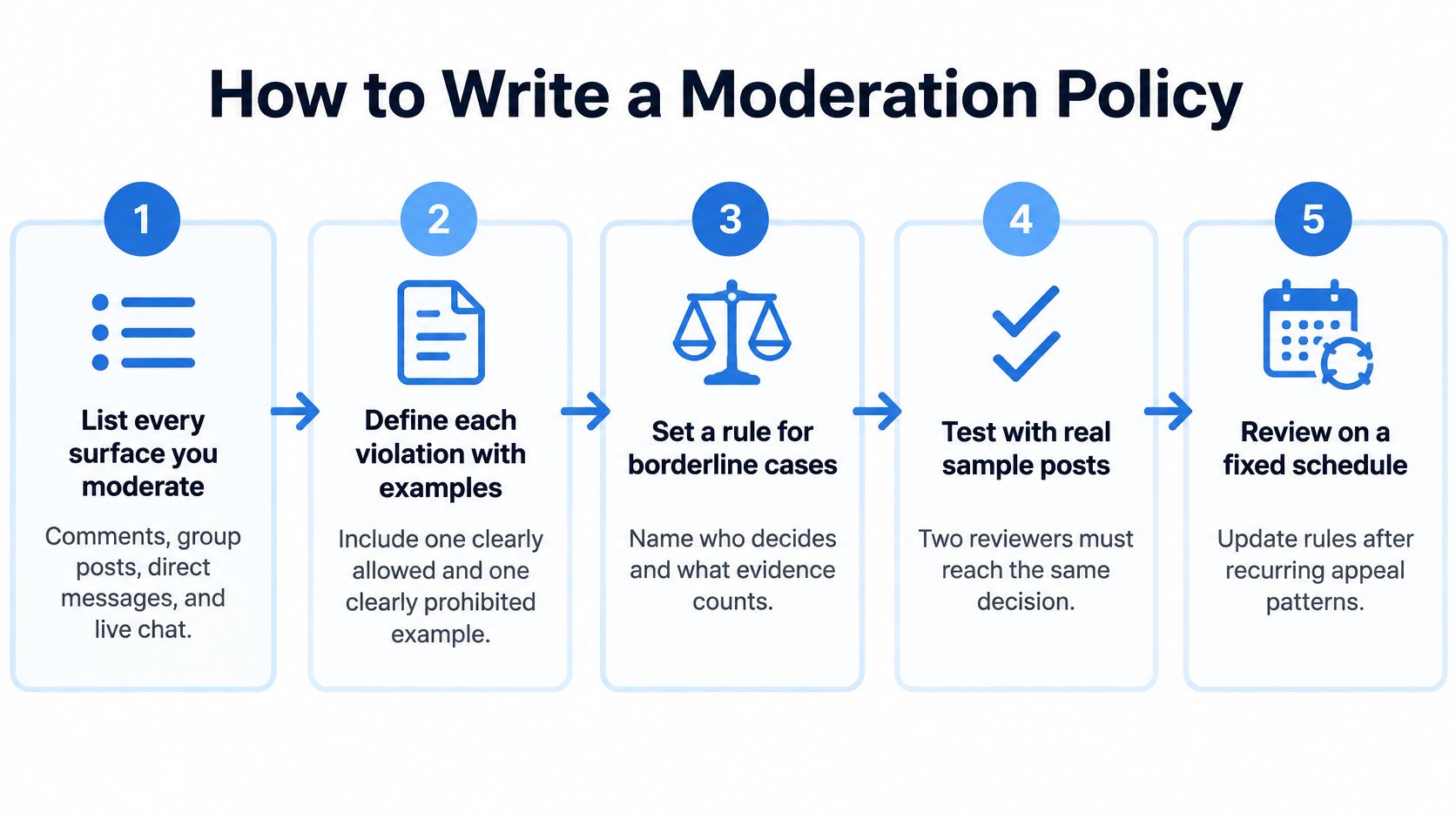
- List the surfaces. Comments, direct messages, tagged posts, mentions, and live chat need separate handling instructions. A common mistake is assuming that a brand can hide or delete content everywhere it appears.
- Define categories through examples. Spam, harassment, hate speech, misinformation, off-topic promotion, and safety concerns need clear boundaries. Overlapping labels leave reviewers arguing about terminology rather than choosing an action.
- Set severity tiers. Threats and imminent safety concerns should bypass routine promotional spam. Treating every negative comment as urgent wastes the attention needed for consequential cases.
- Assign default actions. Each category should specify whether the reviewer replies, hides, deletes, reports, or escalates. A prohibited-content list without action rules still leaves the operational decision unresolved.
- Name owners and backups. Each severity tier needs a responsible person, coverage hours, and an escalation contact. Naming a department rather than an individual makes handoffs unreliable.
- Write response templates and boundaries. Templates should acknowledge the issue, explain the next step, and avoid arguing with abusive accounts. Copying a cheerful sales response into a distressing complaint can make the situation worse.
- Define language coverage. The policy should identify which languages reviewers can assess and when native-speaker input is necessary. Machine translation shouldn't be treated as proof that an idiom is safe or abusive.
- Specify the audit record. The minimum useful fields include platform, content reference, category, action, timestamp, and reviewer. Storing sensitive screenshots without access controls creates a separate risk.
- Schedule a monthly calibration review. Reviewers should compare disputed decisions and update examples or templates. Constantly rewriting rules after isolated complaints makes enforcement unpredictable.
Testing before deployment
A practical test uses anonymized comments that include both obvious violations and ambiguous criticism. Reviewers classify them independently, then explain disagreements.
The policy owner should revise unclear rules before expanding automation. If trained people can't consistently apply a category, a classifier won't make that category clearer.
How Exerta Can Help
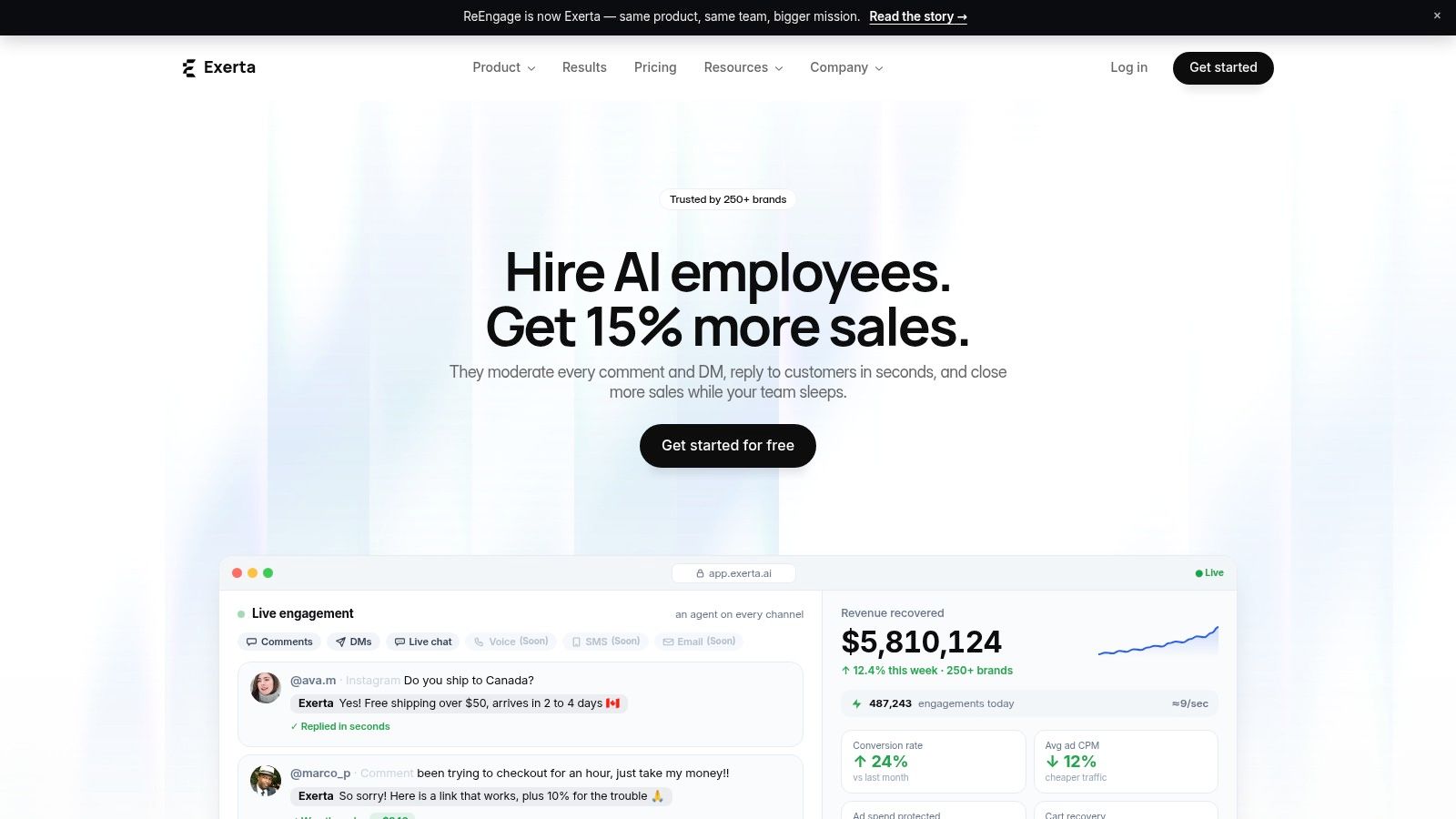
A moderation tool earns its place when it reduces sorting work without hiding mistakes. Exerta is an engagement platform that deploys AI agents across Facebook, Instagram, TikTok, and website chat, combining automated replies with harmful-content moderation. Its guide to social media moderation describes this kind of comment-handling workflow and gives teams a reference point when comparing tools.
Where the platform fits
The useful buying question is narrower than “does it automate replies?” A platform in this category should separate routine questions from cases that need a person, apply policy differently across networks, and leave a record reviewers can inspect. A playful exchange that passes on TikTok may read as abusive in a more formal comment thread, so evaluate how rules are tuned per channel rather than applied as one universal filter.
A practical evaluation should examine:
- Moderation boundaries. Spam and scams need different handling from dissatisfaction or legitimate criticism.
- Escalation quality. Reviewers should test whether sensitive questions reach the appropriate person without an inappropriate automated reply.
- Brand accuracy. Responses about offers, prices, and discounts should match approved information.
- Traceability. The team should be able to inspect which agent acted and why.
- Channel coverage. Confirm that every channel the team needs today is currently supported. Exerta's listed channels are Facebook, Instagram, TikTok, and website chat.
When another approach makes sense
Exerta may suit ecommerce brands, lead-generation businesses, and agencies managing active paid-social conversations. Telehealth or other sensitive operations need particularly careful approval rules and human escalation.
It isn't a substitute for legal judgment or native-language review. Teams that depend on SMS, email, or voice conversations should verify present-day channel coverage before committing, rather than planning around availability they cannot confirm.
Review and Response Workflow by Severity
A severity table gives reviewers a shared order of work. The following targets are suggested operating commitments, not legal deadlines or promises of platform action; teams should adjust them to staffing and time-zone coverage.
Severity tiers and suggested response targets
| Severity | Typical examples | Suggested response target | Owner | Default action |
|---|---|---|---|---|
| Critical | Threats, self-harm concerns, illegal material | Within 1 hour | On-call lead with legal contact | Hide where appropriate, report, escalate |
| High | Coordinated harassment, hate speech, impersonation | Within 4 hours | Community lead | Hide where supported, escalate, document |
| Medium | Spam, off-topic promotion, repeated link drops | Same business day | Community manager | Hide or delete under policy |
| Low | Genuine questions, mild criticism, misunderstandings | Within 2 business days | Community manager | Reply appropriately |
A hypothetical Monday shift
At the start of a Monday shift, a community manager checks the queue for overdue items. A threatening message takes priority over an older discount question because the queue is ordered by potential harm, not arrival time.
The manager preserves relevant evidence, applies the approved protective action, and alerts the on-call lead. Self-harm concerns follow a safety-specific protocol rather than a generic deletion rule, while suspected illegal material requires careful handling without unnecessary downloading or redistribution.
Next, the manager clears obvious spam and answers routine questions. Approved templates provide a starting point, but the manager adapts the response when a customer's circumstances require it.
Safety boundary: A response target measures how quickly the team begins appropriate handling. It doesn't guarantee that an incident will be resolved within that period.
Before the campaign goes live
The publishing reviewer checks each destination's caption, media, audience meaning, and potential policy conflicts. Uncertain variants remain unpublished until the designated owner decides.
Prioritizing uncertainty can make human review more manageable: an active-learning study of technology-assisted moderation estimated cost reductions of 20%–55% across different datasets and operating conditions. That's evidence for targeted review, not a guaranteed saving for a particular brand.
At shift handover, the manager records unresolved cases and the next responsible person. The useful outcome isn't merely an empty queue: it's an audit record showing the platform, category, action, reviewer, and reason, with enough context for the next person to continue safely.
A Campaign Post Across Eight Networks
Consider a hypothetical homeware brand preparing a spring sale across eight networks for Monday morning. The campaign uses an English pun that reads naturally to its UK audience but resembles an insult in a Spanish-speaking target market.
The team treats each destination as a separate publication decision. A shared campaign concept doesn't justify identical wording everywhere.
Before publication
A native Spanish speaker reviews the audience-specific version before scheduling. The reviewer replaces the pun with a straightforward benefit statement and records why the original wording shouldn't be reused in that market.
The designer also checks text embedded in images. Changing the caption alone wouldn't solve the problem if the same phrase remained on the promotional graphic.
The publishing team then assembles destination-specific captions and compatible media. Approval attaches to those exact versions, not to a generic campaign name that might later contain different copy.
After publication
Shortly after launch, a thread on a network fills with repeated, unrelated promotional hashtags. The community manager checks whether the comments are merely discussing the campaign or deliberately redirecting attention to unrelated offers.
The response follows the evidence:
- Classify the behaviour. Repeated off-topic promotion fits the policy category; ordinary disagreement doesn't.
- Choose an available action. Where hiding is supported and appropriate, the manager hides violating comments rather than assuming an entire thread can be hidden.
- Respond selectively. A relevant participant receives the approved explanation; obvious spam accounts don't require a reply.
- Record the decision. The log identifies the network, affected comments, action, timestamp, and reviewer.
The lesson is operational: approval belongs to a network-specific version and its audience context. Copying one decision across every destination can spread the same mistake as efficiently as it spreads the campaign.
If a platform restricts the legitimate announcement despite that preparation, the team needs another way to reach customers. A timely launch can't depend on an appeal being handled quickly.
Handling Wrongful Removals and Incidents
A compliant post can still receive an automated restriction. The first action should be preserving evidence, not repeatedly reposting the same material or assuming that a new upload will solve the problem.
An academic study of Instagram and TikTok appeals examines how automated processes can leave users without meaningful explanations, timely review, or effective restoration. An appeal should therefore run alongside a continuity plan.

The incident record
- Preserve the original. Save the media, exact caption, restriction notice, and timestamped screenshots where safe and appropriate.
- Identify the reason. Record the cited policy category and whether the restriction affects the post, distribution, or account.
- Submit a focused appeal. Include the relevant context, evidence, submission confirmation, and any displayed deadline.
- Protect the announcement. Use an approved backup channel, such as the brand's website or customer email, without attempting to evade enforcement.
- Control queued content. Pause affected publishing where necessary and assign an incident owner.
A short postmortem should distinguish a platform error from unclear wording, missing context, or an actual policy violation. The team should avoid declaring the cause certain when the platform hasn't explained it.
Checking the recovery
At a scheduled follow-up, the owner should verify whether access and content were restored, record unresolved limitations, and revise the contingency plan. Scheduling software can control queued distribution; it can't determine the validity of a platform decision or guarantee restoration.
Set Up Your Moderation Workflow This Week
The first practical action is a one-page policy covering the brand's most consequential recurring risks. Each category needs an owner, a backup, an example, and a default action.
A small dry run should use anonymized recent comments, with reviewers making independent decisions. Disagreements reveal where the policy needs clarification before automation expands.
A review that leads to changes
At a 30-day review, the team can examine:
- Appeal outcomes. Which decisions were reversed, and what made the original judgment unreliable?
- Urgent handling. How quickly did critical items reach the responsible person?
- Language gaps. Which markets generated unresolved or disputed cases?
- Template quality. Which replies needed repeated manual correction?
The team should use its own results to adjust thresholds, examples, and coverage rather than chase a universal removal target.
For the next campaign, the team can connect accounts through official platform logins in PostWing, compose a core message, and customize its captions and media before scheduling text, image, and video posts across Facebook, Instagram, LinkedIn, Pinterest, Threads, TikTok, X, and YouTube. Only scheduled posts can be edited; disconnecting an account stops scheduled posts from publishing to it. The concrete next step is to pair that publishing calendar with a named moderation owner, an approved version for each destination, and a ready incident record. The scheduler controls distribution timing; the team's policy controls its decisions.